| Happy Birthday : |
 Ski alpin
Bindings
A mechanical safety device that locks a racer’s boot to their ski.
Downhill
An alpine skiing discipline that involves the fewest turns and the highest speeds. Racers on the World Cup circuit can exceed speeds of 130 kilometers per hour.
Downhill Suit
A full-body skin-tight racing suit worn by racers to make themselves as aerodynamic as possible.
Edge
A metal strip along on the sides of skis. Athletes must know when to shift their weight to use more or less of their edges to get the fastest time.
Equipment Controller
A designated person who checks the athlete’s equipment to make sure they are abiding by the rules.
Gates
Poles on a ski course that racers turn around and navigate through as fast as possible.
Giant Slalom
An alpine skiing discipline involving slower speeds, technical turns and a quicker tempo. Each racer has two runs down two different courses. The times are added together and the fastest total time determines the winner. The number of gates in this event ranges from 56 to 70 for men and from 46 to 58 for women.
Groomed Slope€
Ski slope terrain that has been smoothed by grooming equipment.
Gatekeeper
A person who watches a ski race to ensure that every racer passes through each gate properly.
Helmet
A vital piece of protective equipment worn by racers. Its aerodynamic shape allows skiers to race as fast as possible.
Intermediate Time
The time recorded at specific sections of the race course.
Poles
Alpine racers use two ski poles to help them push out of the start gate, allowing them to gain as much momentum as possible before hitting the timing start wand. Poles are straight for technical events and aerodynamically curved for speed events.
Sidecut
The hourglass shape of the sides of the ski, where the waist is narrower than the tip and tail.
Skis
Skis are the most important piece of racing equipment. Ski length varies depending on the alpine event — slalom skis are the shortest and downhill skis are longest. Most World Cup racers travel with as many as 20 pairs of skis per discipline.
Slalom
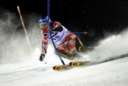
An alpine skiing discipline involving the shortest course and the quickest turns. As in giant slalom, each skier makes two runs down two different courses on the same slope. The times are added together and the fastest total time determines the winner.
Start
In alpine skiing, the athlete may start five seconds before and five seconds after the official start signal. The start referee will give the start notice and then there will be 10 beeps, 1 per second, to indicate the start time window.
Super Combined
An alpine skiing discipline consisting of one downhill run and one slalom run. The times of the two runs are combined and the fastest time wins.
Super-G
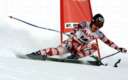
Also know as super giant slalom, super-G is an alpine skiing discipline that combines the speed of downhill with the more precise turns of giant slalom. It involves skiing between widely spaced gates as in giant slalom, but with fewer turns over a longer course and with higher speeds — similar to those achieved in downhill. The minimum number of gates is 35 for men and 30 for women.
Snowcat
A grooming machine used to produce the best terrain for alpine racers.
Wax
A soft substance applied to the base of a ski for protection and to improve its gliding properties. A racer’s wax choice can determine whether they come first or tenth.
White Out or Mid-Mountain Fog
Poor visibility caused by a combination of fog and snow, usually at high altitudes. In Whistler, this condition is termed mid-mountain fog.
Wind-Chill Factor
Taking wind speed into account when determining the outside air temperature.
Copyright Sportquick/Promedi

 (2-3-89) - Article du: 24/04/2024 12:43
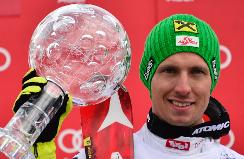 |
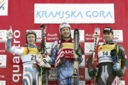
La super star autrichienne : huit fois vainqueur de la Coupe du monde au général, deux fois champion olympique et cinq fois champion du monde. Il fait partie des meilleurs skieurs de l'histoire (spécialiste du slalom et du géant) affolant les statistiques entre 2009 et 2019 (8 Coupes du monde dont un grand chelem, en 2015 et un record de 20 petits globes). Il est le premier skieur de l'histoire à remporter la Coupe du monde au général quatre, cinq, six, sept puis huit fois de su... |
 |
Les skieurs les plus titrés - Hommes Total Descente Super-G Géant Slalom Combiné Adrien Théaux 11 2007-2018 4 7 - - - Luc Alphand 10 1985-1997 8 1 - ... |
|
Ils sont organisés tous les ans depuis 1946, tout d'abord en descente et slalom puis au fur et à mesure dans d'autres disciplines. ... |
|
Ils sont organisés tous les ans depuis 1946, tout d'abord en descente et slalom puis au fur et à mesure dans d'autres disciplines. ... |
|
Ils sont organisés tous les ans depuis 1946, tout d'abord en descente et slalom puis au fur et à mesure dans d'autres disciplines. ... |
|
Ils sont organisés tous les ans depuis 1946, tout d'abord en descente et slalom puis au fur et à mesure dans d'autres disciplines. ... |
|
Ils sont organisés tous les ans depuis 1946, tout d'abord en descente et slalom puis au fur et à mesure dans d'autres disciplines. ... |
 (3-5-97) - Article du: 16/04/2024 14:32
 |
Originaire des Vosges, il est la nouvelle pépite tricolore en slalom. Benjamin de l'équipe de France, il avait terminé 4eme du slalom (à seulement 4 centièmes de seconde de la médaille de bronze) et par équipes aux Jeux Olympiques en 2018. Il devient champion olympique de slalom en 2022, premier médaillé d'or français en ski alpin depuis Antoine Dénériaz en descente en 2006. 4eme de slalom aux championnats du monde en 2023. En 2019, pour sa deuxième saison au plus haut niveau, il... |
.jpg) |
Coupe du Monde de Ski Alpin Historique L’idée d’une Coupe du monde a été lancée en 1966 par un journaliste français Serge Lang et quelques passionnés de ski dont Honoré Bonnet (directeur des équipes de France de ski alpin) et l’Américain Bob Beattie. Le projet a tout de suite eu l’appui du Président de la Fédération Internationale de Ski, Marc Hodler. En décembre 1965, le quotidien de sport français, l’Equipe, organisait un circuit européen du nom de ‘Trophé... |
|
Promedi Copyright Sportquick/Promedi ... |